
Want a More Consistent Yoga Practice? Start With a Journal
The Consistency Struggle Is Real, But Maybe It's Not What You Think
"Deepen your breath, bring awareness back to your body. Wiggle your fingers and toes, feel energy move through your body again. Bend your right knee and then your left. As you turn to your side, slowly open your eyes adjusting to your outer surroundings. Gently make your way to a seated position."
The teacher guides you through the end of class and wishes you well as you head out the door. You feel amazing. Calm, relaxed, warm, settled. This continues effortlessly for the next three months. You have made it a priority. It is in your calendar, and you love practicing.
Then there is a family emergency, you need to be home taking on some extra responsibilities or maybe work becomes more demanding and you need to start putting in more hours at the office. Either way, you find yourself in the same pattern. You look at your schedule, you see yoga on there, but you cannot get away, so you make a promise to yourself to go over the weekend. The weekend comes and goes. You are running errands and every free moment seems to be taken by something unexpected.
This goes on for a few weeks. Finally, after what feels like an eternity, things at home settle down. Your responsibilities lessen. Work slows down and you are no longer needed to put in overtime or pick up extra hours. Yoga is still on your calendar. You look at it. 6:30 pm, you could get there with lots of time to spare. But you have lost your motivation. What will the teacher think? She probably thinks I hate her, or that I didn't like her class. I'll be so embarrassed. Everyone else will be so far ahead of me. I have fallen so behind. I feel so weak. The ruminations are endless. You tell yourself maybe next week. But just like when the days were filled, next week comes and goes and you skip it again.
You feel terrible, guilty even for being so undisciplined. How could you let yourself go like that? You were doing so well. Defeated, you take your rolled up mat and put it in the closet. You cancel your membership and think maybe I'll go back someday when I can be more consistent.
But here's the thing: you were consistent. Life just got a little busy. That is completely normal. There is nothing inherently wrong with you. You are not undisciplined and you do not lack willpower. You just feel the heaviness that comes along with starting over. It is different for everyone, but we all experience it. For some it might look like failure. For others it is guilt or shame. Still others experience a lack of confidence or a sense of defeat. However, this heaviness is self-imposed. We place it on ourselves, and it does not have to be this way.
Maybe the real reason you do not go back is not because you are ashamed that you abruptly stopped attending classes or that you are undisciplined, but rather because your connection to your practice was still very external. You relied on accountability from the teacher or the friends you made in class. None of this is wrong, but it is also very common. Classes are designed this way to keep you coming back and sticking with it. The problem lies in when this falls apart and we lose that connection.
The real problem is not that you are being inconsistent. It is that you are not connected at a deeper level. You are not connected to your yoga practice. It is not quite yours yet. The goal, then, is to make it yours. That is what this post is all about: learning to connect yoga not just to one single moment of your day but to your entire life.
Connection Over Consistency
Scroll five minutes on social media and you are bombarded by fitness and wellness advice that screams consistency is key. Consistency is vital to success. Consistency is the only way to make progress. And yes, there is truth to that. However, what these quotes fail to acknowledge is that life does not look the same for everyone. Some people have kids. Some people have demanding jobs. This mentality of "consistency is the only way to make progress" is flawed because kids get sick and you need to be there to care for them. Work gets hectic and that is what pays your bills. Consistency implies control over your schedule and your choices, but as you know, sometimes we do not always have that control.
All of a sudden, what was meant to be something positive gets turned into something negative. Miss a day, you feel like you have let yourself down. Miss a week, you feel like you have failed. Miss a month and not only have you let yourself down and failed, but now you have to start all over. That is a hard pill to swallow. Consistency looks good until real life kicks in. That is why this message is flawed. It keeps you stuck in a very external environment where you feel you need to be in control of every moment of every day, and if you cannot, then you have failed. You have not failed. This strict, rigid mindset has failed you.
While consistency is non-negotiable and controlled, connection is flexible, personal, and individual. It is what brings you closer to your practice because it is no longer about what you cannot do, but rather what you can do. It is not about how others feel; it is about how you feel. It is not about being bound by a time; it works around your time. Connection looks within. It asks you how you are feeling today, not because it has to but because it is truly invested. It offers to meet you where you are rather than trying to fit you into a predetermined time slot. Connection asks what I need today, whereas consistency demands that you get it done.
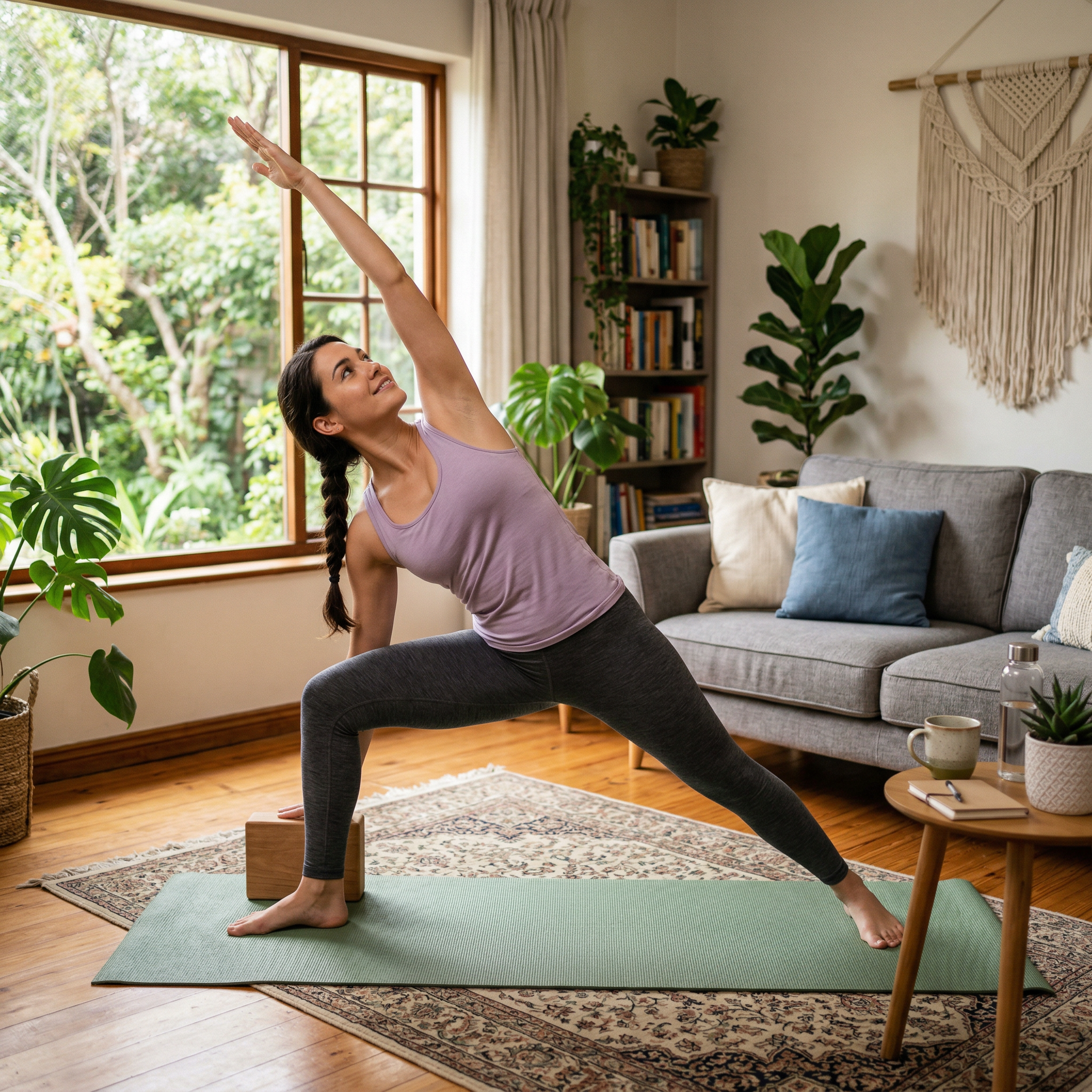
Connection in regard to your yoga practice might look something like coming home from a long day at work, looking at your calendar, and instead of saying I'll push myself through a yoga class, you walk over to the closet, pull out your mat, roll it out on the kitchen floor, and consciously deepen your breath for two minutes, maybe move through a few flowing cat-cows, and call it done. Connection might be settling the kids into bed after the nightly routine, rolling out your mat in your bedroom, journaling, doing a few seated stretches, and taking a short savasana before you go to sleep. Connection might be getting the kids off to school, rolling out your mat, and practicing a few poses you love in your living room before you tackle the day. Hopefully you are starting to see a pattern here. It is not about doing it all or doing nothing. It is about doing something for you, even something small, and counting it as something of importance.
Yoga might not always be at a fancy studio at a specific time on a specific day, and that is okay. It does not have to be that way for it to count. In fact, yoga was never really meant to be that way at all. Yoga was designed to be integrated into every part of your life. It was meant to be a path that leads you to learning more about yourself and your truth, and you can only find that by connecting and becoming aware of not just your outer world but your inner world. Yoga can be at home, in your garden, or in the break room at work. There is no magic place that yoga has to happen in order for it to be effective. The effectiveness of yoga comes from how connected you are to yourself. The poses you practice and the shapes they create are tools to help you understand your body, the way it moves or doesn't, the way your mind lands on a particular feeling or thought, the way your energy shifts when you hold or flow through different postures. That is the cool thing about yoga postures. They give you a starting point to dive deeper into who you are. When you have this connection, stepping back onto your mat, even after a long reprieve, will feel like coming home. No guilt, no frustration, no judgment, just you and your mat wherever that may be.
When you approach yoga from a place of connection, something shifts. You are no longer just moving your body; you are learning from it. Every breath, every posture, every pause becomes feedback, a way to understand what is really going on beneath the surface. But in a life that moves as fast as yours does, those moments can get lost just as quickly as they come. Journaling gives you a way to hold onto them. This is one of my favorite ways to deepen my connection to my yoga practice.

What Journaling Actually Does for Your Brain and Practice
Now that you are no longer measuring your success by how many days you showed up but by how deeply you are able to connect when you do, something starts to shift. Your practice feels different. More supportive. More personal. More yours. But in the middle of busy days and constant demands, that connection can still slip through the cracks. Journaling is what brings you back to it. It helps you slow down, process, and actually see the changes happening, even the ones you might have missed. Here is what journaling is really doing for your brain, your body, and your practice.
From a neurological perspective, journaling plays a powerful role by activating the prefrontal cortex, the part of your brain responsible for intention, decision-making, and follow-through. These are the very skills your yoga practice is designed to strengthen. Each time you step onto your mat with intention and take a moment to reflect afterward, you are reinforcing the brain's ability to stay focused, make conscious choices, and follow through in a way that feels aligned, not forced. When you write about your experience, your brain begins to process and store it more effectively. What might have been a fleeting moment, an awareness, a shift in breath, a realization, becomes something more concrete. Something you can return to.
Journaling also supports emotional regulation. Instead of letting thoughts and feelings cycle endlessly in your mind, you move them onto paper, creating space between you and the story. From that space you are able to observe with more clarity rather than react out of habit. When you can see your thoughts more clearly, they begin to lose their grip. You are no longer caught in the narrative; you are aware of it. And while all of this is happening on a mental level, something equally important is happening in your body, because the connection you are building is not just something you think about. It is something you begin to feel.
When students take time to journal their practice experience, they also begin to see the progress that is not always visible in the mirror. It could be something as simple as noticing they take deeper, fuller breaths, or that they can hold a challenging pose for a longer period of time. They may notice that they flow with ease and that their heart rate does not increase as quickly. Noticing progress is one of the most motivating factors in continuing to make slow, steady movement toward regular practice. The movement on the mat creates an experience, and reflection gives you an opportunity to observe those experiences on a deeper level. This creates a desire to return and continue the journey.
Contrast this with the student who never reflects, who just moves through poses, takes a random class, or depends on external validation to stay motivated. While that student may keep moving through the motions, without reflection the experience stays on the surface. Growth goes unnoticed, small wins are overlooked, and the practice starts to feel like just another thing to get through. When it feels like just another task, especially when times get tough, it is easy to let it slide and allow other things to take over. This leaves them falling right back into the cycle of stopping and starting and believing they just cannot stay consistent when they are faced with the opportunity to begin again. Because it is not just about what you do on the mat. It is about what you are able to see within it. And the good news is, creating that awareness does not require adding anything overwhelming to your routine. It can be as simple as taking a minute or two after your practice to jot down what you noticed, how you felt, or even one small win.
Make Your Practice Stick: When and How to Journal for Real Results
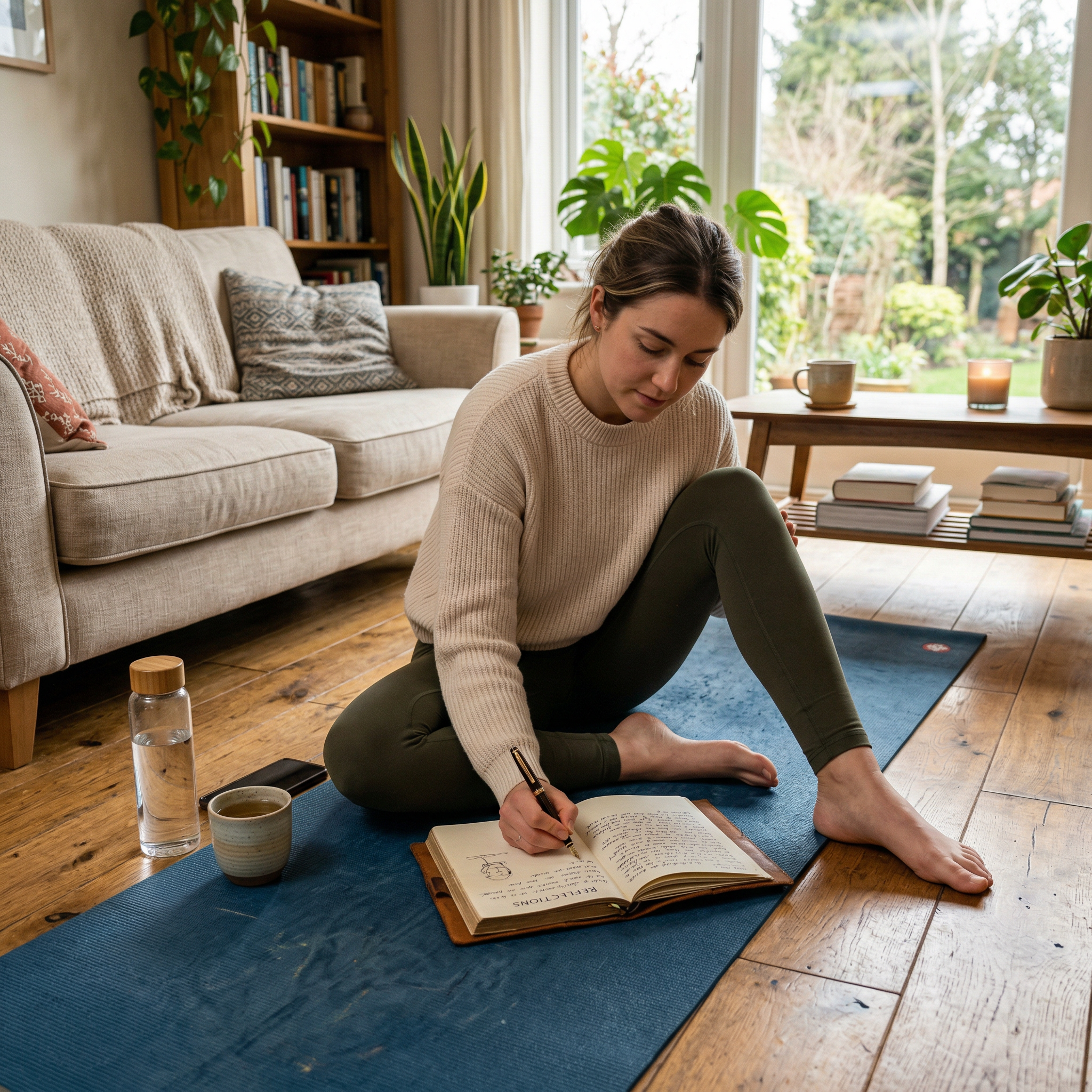
Before you step onto your mat, have a pen and paper or a notebook nearby. A dedicated yoga journal can be helpful, but if you are just starting out, do not overthink it. Just have something to write with and something to write on.
Before you move or take your first deep breath, write down your intention for your practice. Ask yourself one of these questions:
What am I bringing with me onto the mat?
How do I want to feel when I finish my practice?
What do I want to release during this time?
These questions help you check in with where you are and guide your practice with intention. You can use one or all three. This is not about writing more; it is about becoming more aware. One sentence is enough.
Set your paper to the side and begin your practice. As you move, breathe, and flow, stay connected to the question you asked. Notice what comes up. Pay attention to shifts in your body, your breath, and your thoughts.
At the end of your practice, take a moment to reflect. Ask yourself:
What was I able to let go of?
What changed from when I stepped onto my mat until now?
How do I want to feel for the rest of the day moving forward?
Keep it simple. A phrase or a sentence is enough. There are no wrong answers, so try not to filter yourself or overthink it. Let your thoughts come through in the same way you allowed your body to move and your breath to flow. The goal is honest reflection so you can begin to see your own progress. Over time, this simple practice of intention and reflection becomes something you carry with you beyond the mat. You begin to build a deeper connection with yourself, and that connection makes it easier to come back to your practice, even after time away, without guilt, pressure, or the feeling that you have to start over.
Bringing It All Together
You came to yoga looking for something. Maybe it was stress relief, strength, flexibility, or simply a place to exhale. And for a while, it gave you all of that. The moments when life pulled you away were not evidence that you failed. They were just evidence that you are human. The gap between where you were and where you want to be is not a sign of weakness. It is simply an invitation to return, and connection is what makes returning feel possible.
When you shift from chasing consistency to building connection, everything changes. Your practice stops being something you have to earn or keep up with. It becomes something that belongs to you, something that meets you where you are whether that is on a studio floor, in your kitchen, or sitting quietly on the edge of your bed before the rest of the house wakes up. That is the practice. That is the connection.
Journaling is one of the simplest and most powerful ways to deepen that connection. It does not require a lot of time or a lot of words. It just requires a willingness to pause, check in, and notice. Over time those pauses become the bridge between your practice and your life.
If you are ready to start but are not sure what to write or where to begin, I created a journal called Practice, Reflect, Evolve specifically for moments like this. It is minimalist by design and takes the guesswork out of what to say. Each entry includes prompts to help you set an intention before you practice and reflect on what you felt afterward, including what you want to carry with you into the rest of your day. It is designed for beginner journal writers and for anyone who wants to move beyond just showing up on the mat and start building a real connection to their practice. You can find Practice, Reflect, Evolve on Amazon and Barnes and Noble. No pressure, no agenda. Just a simple tool to help you make your practice yours.